
Dans les machines automobiles et industrielles, les composants filetés jouent un rôle important dans la création de connexions mécaniques sécurisées. Cependant, fastening performance depends on more than simply having an internal thread. The position, concentricité, and dimensional accuracy of the threaded bore can directly influence how smoothly a bolt or shaft engages with the component. Donc, accurate internal thread alignment is essential for applications that require stable positioning and dependable mechanical strength. UN composant CNC à filetage coaxial is designed with an internal threaded bore aligned with the central axis of the part. This structure helps maintain a consistent connection between the fastener and the component. Par conséquent, it can support smoother assembly, more uniform contact, and better positioning in precision mechanical systems.
How Coaxial Internal Threads Improve Bolt Fastening
When a threaded bore is properly aligned with the component’s central axis, the bolt can enter and engage more evenly. In contrast, misalignment may increase friction, create uneven contact, or make installation more difficult. Over time, these issues can contribute to inconsistent fastening performance. The coaxial threaded CNC component uses CNC turning and internal tapping or threading to produce an accurately positioned bore. En outre, dimensional inspection helps verify critical features after machining. This combination of controlled processing and inspection allows the threaded structure to maintain consistent geometry.
Par conséquent, manufacturers can achieve more predictable fastening results during assembly. The design is particularly useful when accurate positioning and secure mechanical connections are important to the performance of the final assembly.
Stepped Cylindrical Design Supports Mechanical Integration
The component features a stepped cylindrical structure with symmetrical upper and lower sections connected by a transitional cylindrical area. This geometry provides a compact form that can be integrated into various mechanical assemblies. En plus, the outer surface includes knurled or anti-slip texturing. This feature can improve handling during installation and provide additional grip when the component needs to be positioned or adjusted manually. Meanwhile, the internal threaded bore provides the primary fastening or shaft-mating function.
With an approximate diameter range of 8–25 mm and a height range of 10–30 mm, the component can accommodate different equipment and assembly requirements. Donc, selecting the appropriate dimensions can help optimize space utilization without sacrificing connection performance.
CNC Machining Process Ensures Consistent Accuracy
Precision manufacturing requires careful control at every production stage. The manufacturing process begins with CNC turning to create the stepped cylindrical profile. Suivant, external knurling is applied where required, followed by internal hole tapping or threading. After machining, secondary deburring and cleaning remove sharp edges and machining residues. En outre, final dimensional inspection can be performed using a coordinate measuring machine (MMT) or optical comparator. These inspection methods help confirm critical dimensions and maintain consistency across production batches.
Caiyi Precision applies controlled machining processes to support reliable production of precision mechanical components. Par conséquent, customers can obtain parts with stable dimensions for applications where repeatable assembly performance is required.
Material Options for Different Working Conditions
Material selection can significantly affect strength, weight, résistance à la corrosion, and service performance. This component can be produced from carbon steel, acier inoxydable, alliage d'aluminium, and other suitable materials according to application requirements.
Carbon steel is suitable when mechanical strength is a major consideration. On the other hand, stainless steel can provide better corrosion resistance for environments where moisture or exposure to corrosive conditions is a concern. Aluminum alloy offers a lighter alternative when reducing component weight is important. Donc, flexible material selection allows the component to be adapted to different mechanical systems and operating conditions.
Surface Finishing Adds Protection and Consistency
After machining, appropriate surface finishing can further improve the usability of the component. Deburring helps create smoother edges and reduces unwanted sharp surfaces. Light polishing or barrel finishing can also improve surface consistency and overall appearance. En outre, some production requirements may call for anti-rust treatments such as black oxide or phosphating. These treatments can enhance corrosion resistance and provide a more uniform surface finish. Par conséquent, the finished component can better match the requirements of specific mechanical applications.
Key Advantages of the Component
The main performance benefits can be summarized as follows:
- Accurate Thread Alignment: Keeps the internal threaded bore properly positioned along the component axis.
- Smooth Fastening: Supports easier bolt or shaft engagement during assembly.
- Stable Positioning: Helps maintain accurate mechanical positioning within an assembly.
- Flexible Materials: Supports carbon steel, acier inoxydable, alliage d'aluminium, and other options.
- Reliable Inspection: CMM or optical comparator inspection helps verify dimensional accuracy.
- Practical Surface Finishing: Ébavurage, polissage, barrel finishing, and optional anti-rust treatment support different requirements.
| Fonctionnalité | Manufacturing Detail | Practical Benefit |
|---|---|---|
| Internal threaded bore | Coaxial CNC tapping/threading | Better fastening alignment |
| Outer structure | Stepped cylindrical profile | Compact mechanical integration |
| Surface texture | External knurling | Improved grip and handling |
| Matériel | Acier au carbone, acier inoxydable, alliage d'aluminium | Flexible application options |
| Finishing | Ébavurage, polissage, barrel finishing | Cleaner and more consistent surface |
| Inspection | CMM or optical comparator | Reliable dimensional control |
Applications in Automotive and Industrial Equipment
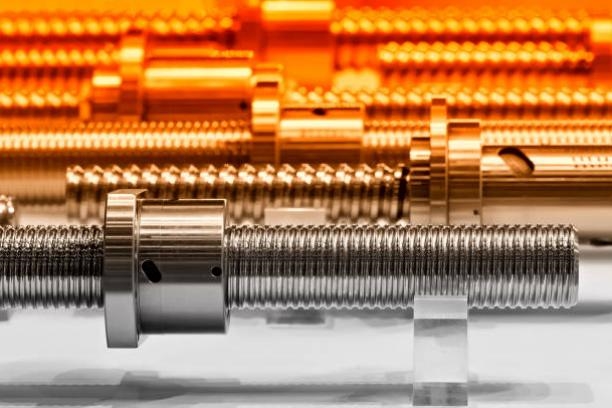
Precision threaded components are commonly required in mechanical transmission and positioning systems. This component is especially suitable for automotive ball screw nut assemblies, shaft mating structures, équipement d'automatisation, and other precision mechanical applications. De plus, its compact cylindrical profile makes it useful where installation space is limited. The combination of an accurately positioned internal thread and functional external geometry allows the component to perform both fastening and positioning roles within a mechanical system.
For customized projects, dimensions, matériels, traitements de surfaces, and machining requirements can be selected according to the intended application. This flexibility helps manufacturers develop components that fit specific assembly structures.
A Reliable Choice for Precision Mechanical Assemblies
A secure threaded connection starts with accurate geometry. By combining coaxial internal threading, controlled CNC turning, suitable material selection, and detailed dimensional inspection, the coaxial threaded CNC component can provide consistent fastening and positioning performance. En outre, its stepped cylindrical design, knurled exterior, and optional surface treatments make it adaptable to different mechanical requirements. With precision-focused manufacturing from Précision Caiyi, this type of CNC-machined component can support reliable assembly performance across automotive, automation, and industrial equipment applications.