
In the early design phase, engineers fill their notebooks with “wild sketches”—visions that defy traditional limits. These ideas often challenge physics, featuring impossible internal cavities and ultra-thin walls. Such moments spark innovation, but they also reveal the limitations of conventional manufacturing methods.
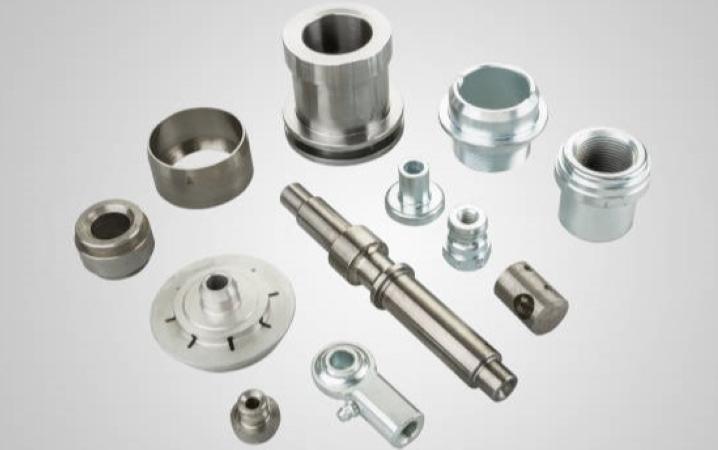
When standard components fall short, CNC lathe machine parts become the solution. Customization turns radical concepts into precise, functional realities, whether in metal or polymer. CNC machining serves as the bridge between bold ideas and high-precision outcomes, transforming raw material into innovative solutions.
1. The Creative Gap: When “Standard” is No Longer Enough
In modern engineering, the “standard part” is a cage. While off-the-shelf components are cost-effective, they are designed for the average, not the exceptional.
The Burden of Innovation
When an engineer is tasked with designing a next-generation medical robotic arm or a high-efficiency hydrogen fuel valve, they are often working in “extreme zones.”
-
Geometric Complexity: The part might need an organic, non-linear flow path to reduce turbulence.
-
Material Specifics: It might require a specific grade of Titanium or PEEK that standard suppliers don’t stock.
-
Integration: A single custom part might need to do the job of five standard parts to save space and weight.
The “Translation” Process
Custom CNC lathe machine parts provide the “Right to Create.” It is a transfer of power from the limitations of the catalog to the limitlessness of the mind. CNC machining doesn’t ask if a part exists; it asks how it should be born.
2. The Language of the Machine: Deciphering the “Impossible” Geometry
The beauty of a custom CNC process lies in its ability to interpret an engineer’s intent through multi-axis precision. What looks like a “wild sketch” on paper becomes a series of mathematical coordinates and tool paths.
The Mastery of Internal Cavities
One of the most profound “poetic” moments in machining is the creation of complex internal structures. Through advanced boring, threading, and multi-tasking turning, CNC lathes can create internal chambers that facilitate complex fluid dynamics or house delicate sensors, all while maintaining a tolerance thinner than a human hair.
Thin Walls and High Strength
In industries like aerospace, “lightweighting” is everything. A custom CNC process allows for the machining of extremely thin-walled structures—sometimes down to 0.5mm—without compromising the structural integrity of the metal. This precision ensures that the “silent poetry” of the finished part is as light as air but as strong as the engineer’s conviction.
3. The “Silent Poetry” of Precision: Why Micron Accuracy Matters
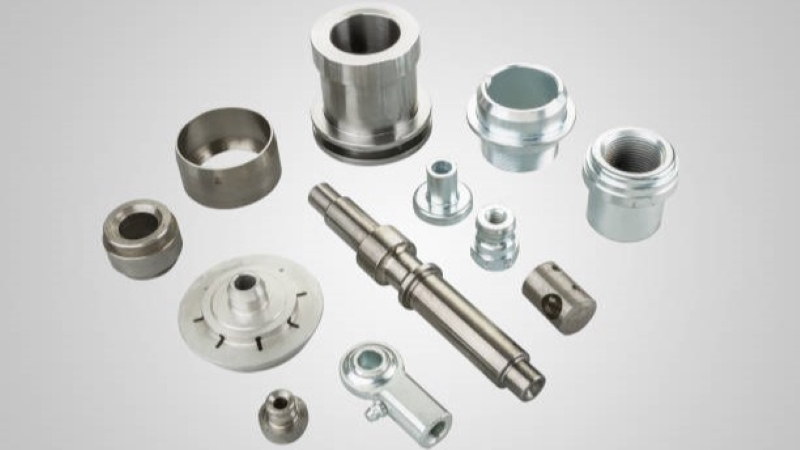
In a high-functioning machine, silence is the ultimate sign of quality. When CNC lathe machine parts are customized to sub-micron tolerances, they fit together with a mathematical perfection that eliminates friction, vibration, and noise.
-
The Zero-Tolerance Fit: Customization allows for “interference fits” and “transition fits” that are tailored to the specific thermal expansion properties of the materials involved.
-
Surface Finish as an Art Form: For parts involved in high-vacuum environments or high-pressure hydraulics, the surface finish ($Ra$) is a functional requirement. Custom CNC turning can achieve mirror-like finishes that ensure seals never leak and joints never grind, allowing the machine to operate in a “silent” state of grace.
4. Material Alchemy: From Exotic Alloys to Engineering Polymers
The “poetry” of a custom part is also found in its substance. CNC customization allows engineers to experiment with “Material Alchemy,” choosing the exact substance that fits the unique environmental stresses of their project.
-
Refractory Metals: Handling Tungsten or Molybdenum for high-heat applications.
-
Medical Grade Alloys: Turning Cobalt-Chrome or Grade 5 Titanium for implants that must live inside the human body for decades.
-
High-Performance Plastics: Machining Torlon or Ultem for weight-critical, high-insulation aerospace components.
Customization ensures that the material choice is never a compromise based on what is available, but a selection based on what is required.
5. ROI of the Unique: The Economic Value of Customization
While custom CNC lathe machine parts may have a higher unit cost than mass-produced items, the “Value of the Unique Solution” provides a massive return on investment (ROI).
-
Reduced Assembly Time: By combining multiple features into one complex custom part, the number of components in a machine is reduced, lowering the risk of assembly errors.
-
Extended Lifecycle: A part designed specifically for its stress environment will outlast a “close-enough” standard part by years, reducing maintenance costs.
-
Intellectual Property Protection: Custom parts are unique to your design. They make your product harder to “clone,” protecting your engineering innovation in a competitive market.
6. Conclusion: Every Part Tells a Story
The journey from a “wild sketch” to a finished CNC lathe machine part is a journey of refinement. It is the process of stripping away the unnecessary until only the essential remains. In this sense, the CNC machine is the editor, and the engineer is the poet.
Custom CNC machining is not just a service; it is the ultimate tool for the curious and the bold. It ensures that no great idea is ever left on the drawing board simply because it was “too hard to make.” In the silent operation of a perfectly machined custom part, one can hear the echoes of the original sketch—now transformed into a functional, durable, and beautiful reality.