
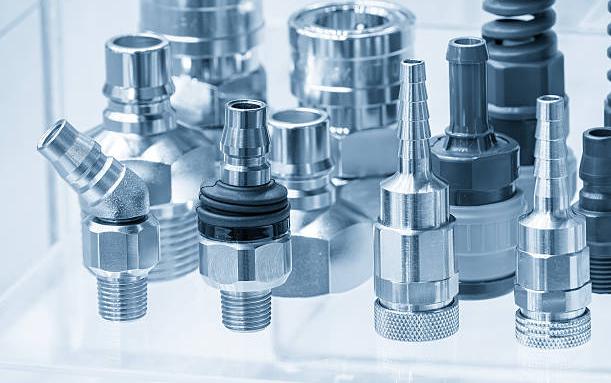
When a driver taps the brake pedal, steers through a sharp mountain curve, or glides over a rugged gravel path, they rarely think about the invisible symphony occurring beneath the chassis. Yet, every fluid movement of a two-ton vehicle relies on a series of “breathing” cycles within the hydraulic system. At the heart of this system are the “nerve endings” of automotive safety and control: automotive hydraulic Swiss-type components.
These miniature marvels—valve spools, pistons, nozzles, and high-pressure connectors—must operate under extreme pressures while maintaining tolerances measured in microns. To achieve this level of reliability, manufacturers turn to Swiss-type CNC machining, a process that ensures the “breathing” of the vehicle remains steady, precise, and leak-free. This article explores how Swiss-type precision engineering dictates the performance of modern automotive hydraulics.
1. The Invisible Guardians: Hydraulics as the Vehicle’s “Nervous System.”
In the modern automotive architecture, hydraulic systems act as the primary interface between human intent and mechanical action. Whether it is the Anti-lock Braking System (ABS), Electronic Power Steering (EPS), or Active Suspension, oil is the medium of power.
The Challenge of High-Pressure Sealing
Hydraulic fluid often operates at pressures exceeding . In such a high-stress environment, the smallest imperfection—a scratch invisible to the naked eye or a deviation in roundness—can lead to internal leakage. Such leaks cause “spongy” brakes or delayed steering response. Therefore, the components must possess a surface finish and geometric accuracy that approach theoretical perfection.
Why “Swiss-Type” is the Standard
Automotive hydraulic Swiss-type components are defined by their slender, complex geometries. Traditional lathes often struggle with long, thin parts because the material deflects under the pressure of the cutting tool. Swiss-type machining solves this by using a sliding headstock and a guide bush, supporting the workpiece immediately next to the cutting tool. This eliminates vibration and allows for the production of parts with sub-micron consistency.
2. One-Hit Manufacturing: The “Turn-Mill” Revolution
Efficiency in the automotive supply chain is driven by reducing “touches”—the number of times a part is handled or moved between machines. Swiss-type CNC machines revolutionize this through “One-Hit” manufacturing.
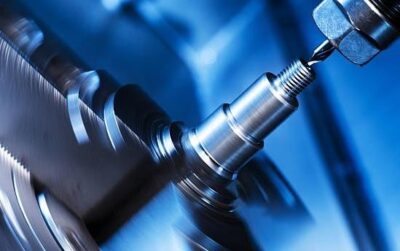
Integrated Processing: Turning, Milling, and Drilling
A single Swiss-type CNC machine can perform turning, milling, cross-drilling, and tapping in a single setup. For a complex hydraulic valve spool, this means:
-
Turning: Creating the main cylindrical body with extreme concentricity.
-
Milling: Carving out precise “metering notches” that control oil flow.
-
Cross-Drilling: Creating internal oil passages that must align perfectly with the external ports.
-
Back-Machining: Finishing the internal threads or seats without needing a second machine.
The Impact on Tolerance
When a part is moved from one machine to another, “stacking errors” occur. By completing every feature in one clamping, automotive hydraulic Swiss-type components maintain a perfect relationship between their various geometric features. This ensures that the roundness, cylindricity, and axial alignment stay within the range, a feat nearly impossible with multi-process manufacturing.
3. The Geometry of Control: Valve Spools and Pistons
To understand the “breathing” of a vehicle, we must look at the specific components that act as the lungs and heart of the hydraulic circuit.
The Precision Valve Spool
The valve spool is the “gatekeeper” of the system. It slides back and forth inside a sleeve to direct oil flow.
-
The Tolerance Gate: The clearance between the spool and the sleeve is often as small as to .
-
The Surface Finish: Swiss-type machining achieves a “mirror finish” (). This smooth surface reduces friction, ensuring that the steering or braking response feels “instant” to the driver.
High-Pressure Pistons and Nozzles
In fuel injection or suspension damping, pistons must withstand millions of cycles without wear. Swiss-type machining allows for the use of high-hardness alloys (like stainless steel or titanium) while maintaining the micro-grooves required for “hydrodynamic lubrication”—a thin film of oil that prevents metal-to-metal contact.
4. Near-Zero Leakage: The Sub-Micron Sealing Edge
The ultimate goal of automotive hydraulic Swiss-type components is the mastery of fluid. In the world of high-performance vehicles, “close enough” is a failure.
Roundness and Cylindricity
If a piston is even slightly “egg-shaped” (poor roundness) or tapered (poor cylindricity), oil will bypass the seal. Swiss-type machines utilize high-frequency spindles and precision guide bushes to ensure the part remains perfectly circular along its entire length. This geometric perfection is what allows a modern braking system to hold a car on a steep hill without the driver having to stand on the pedal.
Micro-Hole Precision
Hydraulic systems often rely on “orifices” or nozzles to regulate pressure. These holes can be as small as in diameter. Swiss-type CNC machines can drill these micro-holes with perfect burr-free edges, ensuring that the oil flow remains “laminar” (smooth) rather than “turbulent,” which prevents heat buildup and noise (NVH) in the vehicle.
5. Material Intelligence: Balancing Strength and Machinability
Automotive environments are brutal. Components face rapid temperature swings from winter to summer in the engine bay.
-
Alloy Selection: Swiss-type machining is particularly adept at handling “tough” materials such as 17-4 PH stainless steel or specialized tool steels.
-
Thermal Stability: Because Swiss-type machines are compact and often utilize oil-based coolants, they maintain incredible thermal stability. This ensures that a part machined at 8:00 AM is identical to the one machined at 8:00 PM, a critical requirement for high-volume automotive production runs.
6. Conclusion: The Nerve Endings of Modern Safety
The next time you feel the smooth, effortless assist of your car’s power steering or the firm, reassuring grip of your brakes, remember the automotive hydraulic Swiss-type components working behind the scenes. These parts are the unsung heroes of the automotive world.
By merging sub-micron precision with the efficiency of one-hit CNC processing, Swiss-type technology ensures that every “breath” of the vehicle’s hydraulic system is controlled with absolute certainty. As vehicles move toward autonomous driving and drive-by-wire systems, the demand for these “nerve endings” will only increase. Precision isn’t just a measurement; in the automotive world, precision is the foundation of trust between the driver and the machine.